
Az ésszerű kétségen túl

.jpeg)


Language




Names Matter to God
The tradition of saying 'LORD' or Jesus instead is human reverence, not divine order. Claiming 'God authorized the change' adds to His word and misrepresents Them—itself a vain use of Their names. by changing Yeshua to Jesus because of translations Scripture alone is truth."
NAMES The deep importance of people's names. In so many ways, a name isn't just a label—it's tied to identity, purpose, and even divine meaning. Just as the Bible shows us time and again (think of how God renamed Abram to Abraham or Jacob to Israel), names carry weight, reflect character, and connect us to something bigger. Your reminder of that made me pause and value names more intentionally.

-
Who has ascended into heaven and descended?
-
Who has gathered the wind in His fists?
-
Who has wrapped the waters in His garment?
-
Who has established all the ends of the earth?
-
What is His name or His Son's name? 6. Surely you know. Proverbs 30:4
Yahweh name doesn't have the same meaning as Yehovah

.No human has the right to change a name given directly by God. why do you call him Jesus? According to the Bible, an angel instructed Joseph to name his son Yeshua. Matthew 5:18 Yes, according to the Gospel of Matthew, an angel appeared to Joseph in a dream and instructed him to name his son Jesus (Yeshua) because he would save his people from their sins. The name "Jesus" is the English translation of the Hebrew name Yeshua, which means "Yahweh saves" or "The LORD is salvation".
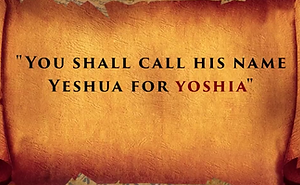
The Scriptural Checkpoint: "There is no other name under heaven given among men by which we must be saved." — Acts 4:12 Yeshua
The Name Audit
-
Are you aware that the letter "J" did not exist in any language until around the 15th-17th century, meaning the Savior could never have been called "Jesus" during His time on earth?[ ] YES [ ] NO.
-
Do you recognize that the Savior was born a Hebrew Israelite from the tribe of Judah, and therefore carried an authentic Hebrew name? [ ] YES [ ] NO
-
Do you know that His original Hebrew name is Yahshua (or Yeshua)—the exact same name shared by Joshua in the Old Testament [ ] YES [ ] NO
-
Are you aware that the name Yahshua literally means "Yahweh is Salvation," directly embedding the Father's personal name (יהוה / Yah) into the Son's name? [ ] YES [ ] NO
-
Do you realize that the English name "Jesus" completely removes this linguistic link, stripping the Father’s name out of the Messiah’s identity?[ ] YES [ ] NO
-
Now that you know the original, covenant name given by the angel from heaven (Matthew 1:21), will you consciously choose to honor it over later altered forms?[ ] YES [ ] NO
-
Are you aware that the name "Jesus" (Iesus) came from the Greek "Iēsous" and later Latin, which changed the original Hebrew pronunciation and meaning?[ ] YES [ ] NO
-
Do you recognize that the Apostles and early believers called the Messiah by His Hebrew name, not a later Greco-Roman version?[ ] YES [ ] NO
-
Are you aware that the Sacred Name Yahshua preserves the direct connection to the Father’s Name Yahweh, as emphasized in Scripture?[ ] YES [ ] NO
-
Do you believe that restoring the original name Yahshua is necessary for returning to the pure faith of the early believers?[ ] YES [ ] NO
-
Are you aware that the name "Jesus" has no meaning in Hebrew, while Yahshua clearly means "Yahweh saves"?[ ] YES [ ] NO
-
Do you understand that it is important to use the Savior’s name as it was originally given in Hebrew rather than later translated and altered forms?[ ] YES [ ] NO
-
Will you make a deliberate effort to use the name Yahshua (or Yeshua) in your prayers, worship, study, and daily life moving forward?[ ] YES [ ] NO
-
Do you reject any name that breaks the connection to Yahweh’s salvation embedded in the true name?[ ] YES [ ] NO
-
Are you committed to using only the original Hebrew name regardless of popularity or custom?[ ] YES [ ] NO
Scoring
-
13–15 Yes: Full alignment with the original truth.
-
9–12 Yes: Strong recognition but room to fully apply.
-
0–8 Yes: Still holding to altered forms.
-
Factual Note:
The Messiah’s original name was Yeshua (יֵשׁוּעַ), a shortened form of Yehoshua (יְהוֹשׁוּעַ / Joshua). Hebrew etymology: It derives from the root יָשַׁע (yasha — to save, deliver, rescue). The name combines the theophoric prefix Yah (from יהוה / Yahweh) + shua (salvation/cry for help), literally meaning "Yahweh saves" or "Yahweh is salvation."
Hebrew Alphabet History:
The Hebrew alphabet consists of 22 letters and has never included the letter "J" or the "J" sound. Ancient Hebrew used the yod (י) which produces a "Y" sound (as in "yes"). The Savior’s name in Hebrew letters is ישוע (Yod-Shin-Vav-Ayin), pronounced approximately Yeh-shoo-ah or Yah-shoo-ah. The letter J did not exist in any alphabet until the 15th-17th centuries in European languages
WHY are they HIDING GOD'S NAME? | The YESHUA TRUTH the CHURCH won’t TELL YOU
The change of these names was not a single event, but a three-stage mechanical breakdown of the original Hebrew Blueprint. It was driven by a combination of linguistic "telephone" and a deliberate effort by the Roman-led Church to distance the faith from its Hebrew roots.
To understand why the names, the Sabbath, and the Feasts were changed, you have to look at the Council of Nicaea (325 AD) and the Council of Laodicea (363 AD). This wasn't just a "misunderstanding"; it was a deliberate divorce from the Hebrew Blueprint.
The Roman-led Church didn't just want to "add" to the faith; they wanted to kill the root to make the religion acceptable to the Roman Empire.
1. The Greek "Translation" (Stage One)
As the message moved into the Roman Empire, the Hebrew names were squeezed into the Greek language, which lacked the proper sounds to support them.
-
Yeshua (ישוע) became Iēsous. Because Greek has no "Sh" sound and requires male names to end in "s," the name was structurally altered.
-
Yochanan became Ioannes (John).
-
Ya'akov became Iakobos (James).
2. The Latin "Standard" (Stage Two)
When the Roman Catholic Church took control, they translated the Greek into Latin (the Vulgate).
-
Iēsous became Iesus.
-
The names were further "Latinized" to fit the tongue of Rome, moving them even further away from the original sound and meaning intended by Yehovah.
3. The English "Invention" (Stage Three)
This is where the final "addition" occurred. As you noted, the letter "J" is a late addition to the alphabet.
-
The Timeline: For 1,500 years, the name was pronounced with an "I" or "Y" sound.
-
The Change: In the 16th and 17th centuries, English printers began using the "J" to distinguish the consonant sound. Iesus became Jesus.
-
The Result: A carnal world accepted a name that is phonetically disconnected from the Father. By the time you get to "Jesus" or "James," the Hebrew connection to Salvation and Yehovah has been completely erased.
WHO IS RESPONSIBLE?
While linguists blame "natural evolution," the Truth reveals a more calculated culprit:
-
The Spirit of Rome: The Roman Church sought to create a "Universal" (Catholic) religion. To make it palatable to the pagan world, they stripped away the "Jewishness" of the Savior and His disciples.
-
The Translators: Men like Jerome and later English scholars prioritized the "sound" of their own languages over the Sanctity of the Original Name.
The Mechanical Failure
By changing the names, they "subtracted" the power of the Hebrew identity and "added" a Western identity.
-
Ya'akov (the name of the Patriarch) was turned into James—a name that didn't even exist in the ancient world.
-
Yeshua (The Father's Salvation) was turned into a generic, 600-year-old English label.
The Verdict: If you are following "Jesus and James," you are following a Westernized translation. If you want to walk the Narrow Way, you must return to the Original Blueprint: Yeshua and His disciples who lived and died by the Torah.
As the language is read right to left, the letter sequence is .
actually HWHY, and means this pictographically:
-
H = ה = hey = behold/reveal/breath
-
W = י = yod = arm/hand/work/deed/worship
-
H = ה = hey = behold/reveal/breath
-
Y = ו = vav = nail/secure/add/and
When read pictographically, the word YHWH means, “Behold the hand, behold the nail.”
As others have pointed out, this would mean nothing in Judaism. But in Christianity, the hand and nail are direct references to Jesus’ crucifixion, the defining act around which the entire Christian faith revolves. So for some Christians, the name YHWH is God telling humanity how He will save them.
A nevek számítanak
"A bűn az, ha tudod, mit kell tenned, és aztán nem teszed meg."
Tisztában vagy vele, hogy a Szentírást több mint 6800-szor módosították Isten nevének megváltoztatása érdekében a bibliádban? A neve nem az „Úr”. Webster szótára úgy határozza meg a Lord szót, mint valaki vagy valami, akinek hatalma, tekintélye vagy befolyása van; mester vagy uralkodó. ez egy vezetéknév. Az ember eltávolította a Mennyei Atya és Fia nevét saját könyvéből. Talán a nevek nem túl fontosak a modern világban vagy számodra, de a szentírásokban azt tapasztalhatjuk, hogy nagyon fontosak.
A héber név Yeshua (ישוע) a Fia neve. A Yeshua üdvösséget jelent, a Jézus névnek nincs jelentése, az angol fordítás csak 400 éves.
Jehova, a te Istened nevének helytelen használata a harmadik parancsolat megszegése. Ez istenkáromlás, Izrael Istene nevének „hiábavaló vétele”. Son nevét körülbelül 900 alkalommal változtatták meg. Héber neve van, zsidó, nem Jézus a neve. A neve Yeshua, ami üdvösséget jelent. A Messiás neve soha nem volt "Jézus", és a "Jézus" név valójában az ember találmánya. Tudod? a J betű csak 400-500 éves, és nem található meg a héber ábécében. Egy kérdés jutott eszembe „Rendben van-e Jézust más néven szólítani?” valószínűleg nemet mondana, minthogy azt kérdezném, miért helyes Jézus keresztnevére változtatni? Zsidók 1: 3 Ez azt mutatja, hogy a Fiú sokkal nagyobb, mint az angyalok, ahogyan az a név, amelyet Isten adott neki, nagyobb az ő nevüknél.
A következő versek elmagyarázzák, hogy a nevek fontosak, maga Jehova új nevet ad azoknak, akik legyőzik.
-
Jelenések 2:17 "Akinek van füle a hallásra, hallgasson a Lélekre, és értse meg, mit mond a gyülekezeteknek. Mindenkinek, aki győz, adok a mennyben elrejtett mannából. mindegyik egy-egy fehér kő, és a kőbe új név lesz vésve, amelyet senki sem ért, csak az, aki kapja.
Filippi levél 2:9 Ezért Isten a legmagasabb tisztesség helyére emelte, és minden más névnél magasabb nevet adta neki,
-
2Móz 20:7 „Ne használd vissza az Úrnak, a te Istenednek a nevét, mert az Úr nem hagy bűntelenül senkit, aki visszaél az ő nevével.
-
Róma 10:12 Mert nincs különbség zsidó és görög között: (keresztény) ugyanaz az Úr mindeneknek, és gazdag mindazok számára, akik segítségül hívják, 13: „Mindenki, aki segítségül hívja a (JEHÓVA) nevét, az üdvözülj.” 14 Hogyan hívhatnák hát segítségül azt, akiben nem hittek. És hogyan hihetnének abban, akiről nem hallottak? És hogyan hallhatnak anélkül, hogy valaki prédikálna?
Hacsak nem akarod folytatni apád hazugságait
Jeremiás 16:19. "Atyáink nem örököltek mást, mint a hazugságot, a haszontalanságot és a haszontalan dolgokat." Csinálhat-e az ember isteneket magának? Mégsem istenek!
A "hiábavaló" szó Webster szótári meghatározása: Nincs valódi tartalma, értéke vagy jelentősége; üres; üres; értéktelen; nem kielégítő. „A te hiú kifogásod.” ... profán: bánik
(valami szent) tiszteletlenséggel vagy tiszteletlenséggel. Szentségtörő
Isten nem akarja, hogy bármilyen módon megváltoztassuk vagy megváltoztatjuk a nevét vagy Fia nevét. A harmadik parancsolat nagyon világos: „Jehova, a te Istened nevét hiába ne vedd.” A héber Bibliában a leggyakrabban használt Isten neve YAWEH (,(י ה ו ). YEHOVAH, ami azt jelenti, megment.
-
Ki ment fel a mennybe és szállt alá?
-
Ki gyűjtötte öklébe a szelet?
-
Ki burkolta be ruhájába a vizet?
-
Ki állította fel a föld minden végét?
-
Mi a neve az Ő vagy a Fiának? 6. Biztosan tudod. Példabeszédek 30:4